
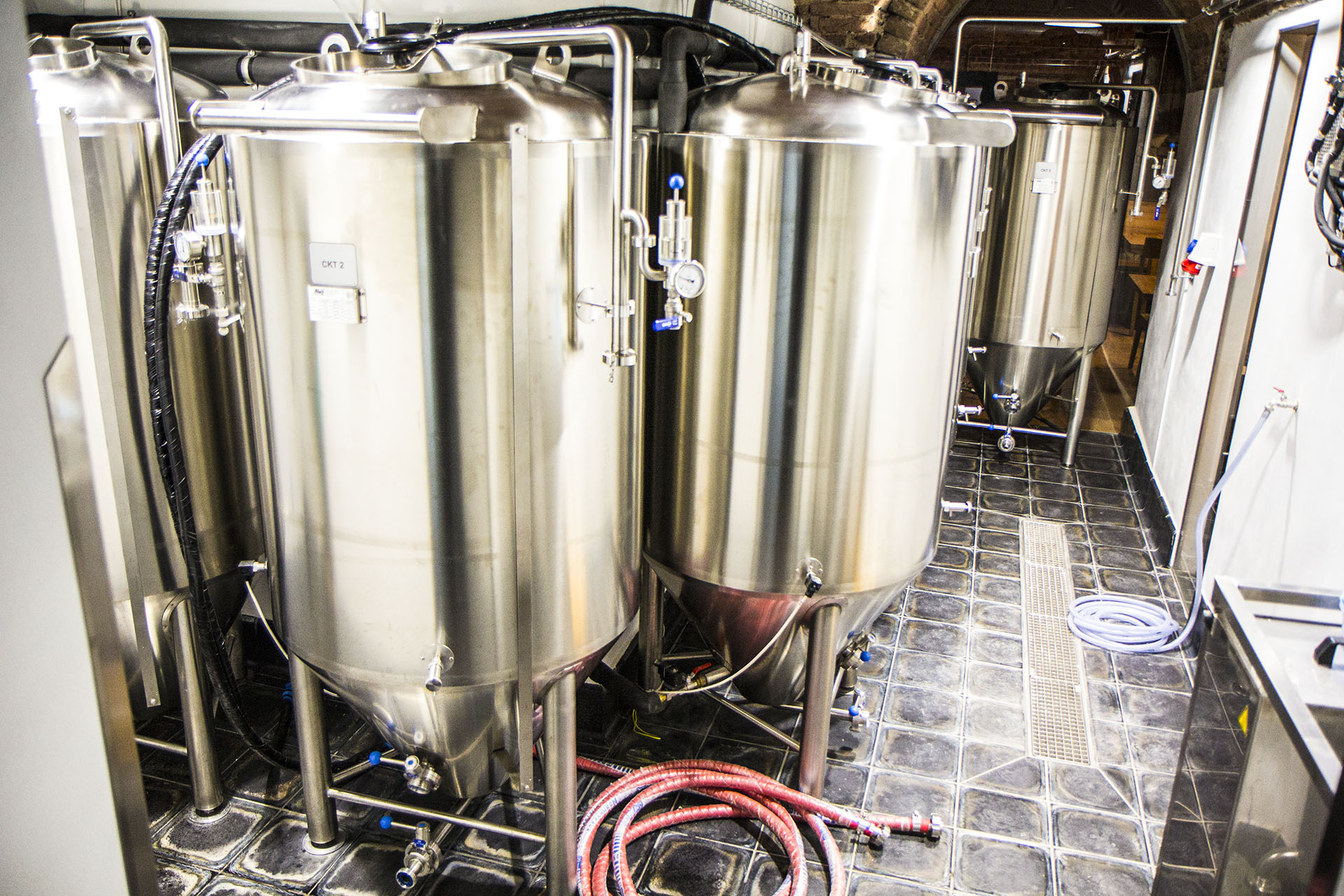
Tank beer is unpasteurised beer that a brewery delivers by tanker to a pub, where it goes into large chilled tanks. From the tank it runs straight to the tap, is never decanted into kegs and does not meet the air as it is poured. Beer from tanks in the brewery itself, like ours, is a slightly different thing: no tanker is involved, because the beer is brewed, matured and poured in one building.
What is tank beer
The brewery fills finished, unpasteurised beer from its storage tanks into a tanker with several separate chambers. At the pub it is met by a tank room (in Czech a tankovna): an insulated, chilled room with stainless steel tanks of 5 or 10 hectolitres.
Inside every tank is a sealed polypropylene bag that is used only once. The beer is in the bag and air presses on the bag from the outside, so the air never touches the beer. Plzeňský Prazdroj says this is good for the quality and shelf life of the beer.
Pipes lead from the tank to the taps, and a flow meter measures how much beer is poured. According to Prazdroj, one tank can feed up to four independent taps.
The system has a condition. A tank room pays off only where a lot of beer is poured: Prazdroj writes that a pub has to get through a tank within about a week, or three days after it is tapped. Slower pubs are better served by traditional kegs.
None of this is new. According to Prazdroj the first modern tank room stood in the Plzeň pub U Korbele in 1995, and by 2019 there were more than eight hundred of them in Czechia.
Tank beer, keg beer and beer from tanks in the brewery
Keg beer is filled into stainless steel KEG kegs, at Prazdroj for example of 15, 30 or 50 litres. Once a keg is tapped, gas pushes the beer out, most often a mix of CO₂ and nitrogen. Pasteurisation can be added at filling: the beer is heated to kill microorganisms so that it keeps longer.
| Tank beer delivered by tanker | Keg beer | Beer from tanks in the brewery itself | |
|---|---|---|---|
| Where it is brewed | at the supplier's brewery | at the supplier's brewery | in the building where it is poured |
| How it travels | by tanker to the tank room | in kegs | it does not |
| Where it waits to be poured | in a tank, inside a bag | in the keg | in the tanks behind the bar |
| What pushes it out | air pressing on the bag | gas pressing on the beer | nitrogen, in our case |
| Pasteurisation | Prazdroj's tank beer is unpasteurised | may be done at filling | we do not pasteurise |
The last column describes our own practice. We brew at Lidická, all our beers are unpasteurised and unfiltered, and we pour them from tanks right behind the bar. The beer matures in lager tanks at 2 °C and, according to the diagram on our website, goes into the glass at 5 °C. What happens in the fermentation tank is explained in our article on the CCT tank.
Does tank beer really taste different?
Pasteurisation stabilises beer and extends its shelf life. Done gently, you cannot tell; otherwise it can give the beer a flavour of its own. Unpasteurised beer, on the other hand, is more sensitive to warmth and age, which is why it needs cold storage and a quick turnover. (In US spelling it is unpasteurized beer; the meaning is the same.)
Unfiltered beer keeps traces of yeast and proteins. That is why it is often cloudy and fuller in flavour, as we wrote in our news post about rinsing glasses. Filtration removes these substances.
One thing is true of every system: a lot depends on the pub. Prazdroj recommends professional sanitation of the beer lines once a week and a basic rinse of the pipes every day. A dirty line spoils the best tank just as a badly rinsed glass does. How a properly poured beer looks is described in our guide to Czech beer pours.
At our place beer from tanks and kegs is pushed by nitrogen, not compressed air. For keg beer, Prazdroj's recommendations rule out air compressors because they oxidise the beer.
Where to drink tank beer in Prague
Around Anděl and Smíchov there are quite a few pubs with tanks. Going by the venues' own websites, we have checked these, for example:
- U Bílého Lva on Na Bělidle is an old Smíchov pub next to the Staropramen brewery. It pours Staropramen 12° straight from the tank.
- Tradice at Anděl is a Pilsner Urquell Original Restaurant and pours Pilsner Urquell from the tank.
- Plzeňský restaurant Anděl on Nádražní keeps its tank Pilsner in six tanks of a thousand litres each.
We are a different case. Our beer has not been anywhere: it was made in the building where you drink it. It is two minutes' walk from Anděl metro station, at Lidická 337/30. Have a look at the menu or reserve a table in our restaurant. You will find more places nearby in our guide to Anděl and Smíchov.
Frequently asked questions
Is tank beer unpasteurised?
According to Prazdroj, its tank beer is unpasteurised. Other breweries and pubs may do it differently, so ask the bartender.
Does tank beer taste different from keg beer?
It may taste fresher, because it is handled less on the way and never meets the air. But the cleanliness of the lines and the pouring matter just as much.
Where in Prague can I sit down to unpasteurised tank beer?
In pubs with a tank room. Several are around Anděl, see above. Our beer is unpasteurised and we pour it from tanks behind the bar.
What is a tank room (tankovna)?
An insulated, chilled room at the back of a pub where the stainless steel tanks stand. A tanker has to be able to drive up to it, because the beer is pumped into the tanks through a hose straight from the lorry.
Is the beer from your tanks the same as tank beer in pubs?
No. Tank beer is brewed elsewhere and delivered by tanker. Ours is brewed in the building and poured from tanks behind the bar.
Why do you not filter or pasteurise your beer?
According to our article on the CCT tank, filtration removes part of the flavour and aroma along with the yeast, and pasteurisation changes the flavour profile of the beer. So we let the yeast settle in the conical bottom of the tank and draw it off from below.
Come and taste it
We are a two-minute walk from Anděl metro station, at Lidická 337/30.
Reserve a Table