Pour a beer, tap a beer, or even draw a beer? So which one is correct? All of the answers are right – and actually none of them. All these expressions evolved gradually as beer culture developed. And each one tells us a bit of the history of Czech brewing.
"Nalít" (Pour) – the oldest expression
Originally, beer was simply poured from a jug. In the days when tap handles and beer technology didn't exist yet, beer was simply transferred from one vessel to another. The barkeeper took a jug, scooped beer from an open barrel and poured it into a tankard or goblet. Simple, straightforward – and that's where the Czech word "nalít" (pour) comes from.
"Natočit" (Tap/Draw) – from the barrel crank
In the 19th century, hand-crank pressurization technology spread. The principle was simple: the barrel had a wheel or crank that was used to pressurize it – the barkeeper literally turned (točil) the wheel to create enough pressure for the beer to flow from the tap.
And that's exactly why people said "natoč mi jedno" (draw me one) – because the barkeeper had to turn the crank. This is also the origin of the common Czech phrase "točené pivo" (draught beer). Even though nobody turns a wheel anymore, the name stuck.
"Načepovat" (Tap from the bung) – from the wooden bung
This expression probably comes from the fact that wooden barrels have a plug called a "čep" (bung). The bung is a wooden stopper used to seal the hole in a barrel. When the barkeeper wanted to serve beer, he had to pull out the bung or drive a tap into the barrel.
Hence "načepovat pivo" (to tap beer from the bung) – literally letting beer flow through the bung. And hence "čepované pivo" (tap beer), which is probably the most commonly used term in Czech beer culture today.
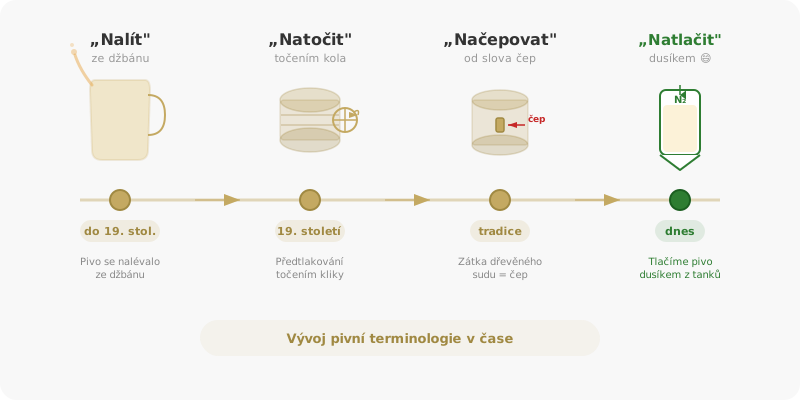
"Pour"
The oldest method – beer was simply poured from a jug into a goblet.
"Draw/Tap"
In the 19th century, barrels were pressurized by turning a wheel. Hence "draught" beer.
"Tap from bung"
The wooden plug of a barrel = bung (čep). Hence "tap" beer.
"Push"
We push beer using nitrogen from tanks. But we hope this term won't catch on 😄
And how does it work at Andělský Pivovar?
If we wanted to be technically correct about the technology we actually use, we'd have to say "push me a beer" at our brewery. Why? Because we push beer from tanks and kegs using nitrogen.
Nitrogen (N₂) is an inert gas that doesn't push beer into contact with oxygen – unlike compressed air, it doesn't oxidize the beer or affect its taste. Thanks to this, our beer maintains its fresh, full flavor from the first to the last pint from the tank.
😄 Will "push" catch on?
We kind of hope this term won't catch on. Imagine walking into a pub and saying: "Barkeep, push me one!" Sounds a bit like an auto repair shop, doesn't it? So feel free to say pour, tap, or draw – we'll happily push that beer from our tanks for you. 🍺
So which term is correct?
The answer is simple: all of them. Each expression reflects a different era and a different technology. Language evolves alongside the craft, and none of these terms is "wrong." They are beautiful linguistic fossils that remind us of the rich history of Czech brewing.
"It doesn't matter whether you say pour, tap, or draw. What matters is that the beer is good. And that's what we take care of here."
– Adam Roudnický – Brewmaster
🍻 Summary
Pour (Nalít) = from a jug (oldest)
Draw/Tap (Natočit) = from turning a crank on the barrel (19th century)
Tap from bung (Načepovat) = from the word bung (wooden barrel plug)
Push (Natlačit) = modern technology (nitrogen), but please don't say it 😄
Come and have one "pushed" for you
Whatever you call it – reserve a table and taste fresh beer straight from the tanks!
Reserve a Table