
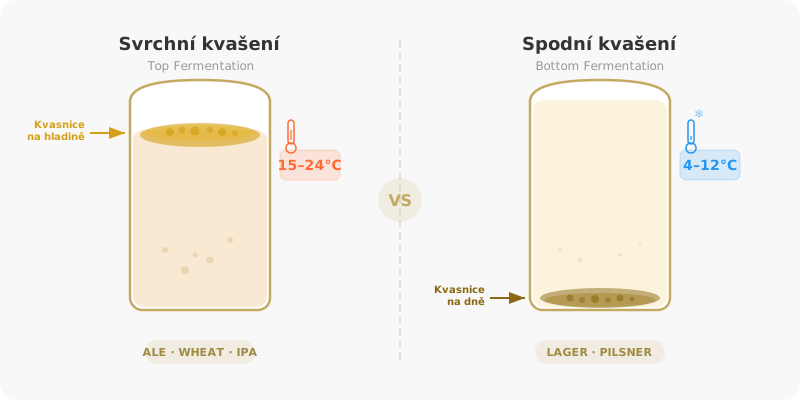
You might think that top-fermented beer ferments at the surface of the tank and bottom-fermented beer ferments at the bottom. That's not quite accurate. The reality is far more interesting and hides fascinating microbiology that fundamentally influences the taste, aroma and character of every beer you drink.
The myth of "top" and "bottom"
The terms "top" and "bottom" fermentation do indeed refer to the behavior of yeast during fermentation, but not as literally as you might think. Both forms of fermentation take place throughout the entire volume of the tank – yeast moves throughout the liquid, processing sugars into alcohol and carbon dioxide.
The key difference lies in where the yeast migrates during and at the end of fermentation, and at what temperatures it works best.
Top Fermentation – Temperature that creates flavor
Top-fermented beers ferment at higher temperatures, typically between 15–24°C. At these temperatures, yeast is very active – it multiplies rapidly and produces large amounts of CO₂. It's precisely this carbon dioxide that lifts the yeast to the surface, where it forms a characteristic thick foam pillow.
"Top-fermenting yeasts are like energetic artists – they work quickly, at higher temperatures, and leave a distinctive aromatic imprint on the beer. Fruity, spicy and floral tones – all their doing."
– Adam Roudnický – Brewmaster
Thanks to the higher fermentation temperature, top-fermenting yeasts produce more esters and phenols – aromatic compounds that give beer fruity (banana, pear, citrus) or spicy tones (clove, pepper). That's exactly why ales, wheat beers and IPAs have such a distinctive and complex flavor profile.
🍺 Typical top-fermented styles
- Pale Ale & IPA – Hop bombs with citrus and tropical tones
- Wheat Beer (Weizen) – Banana and clove aroma
- Stout & Porter – Roasted, chocolate and coffee flavors
- Belgian Ale – Complex spicy and fruity profiles
- Saison – Farmhouse ales with peppery character
Bottom Fermentation – Precision and purity
Bottom-fermented beers ferment at lower temperatures, usually between 4–12°C. Under these cooler conditions, yeast works more slowly but more thoroughly. It is able to better process all available sugars and achieve better attenuation.
At the end of fermentation, the yeast sinks to the bottom of the tank – hence the name "bottom." The lower temperature suppresses the formation of esters and phenols, resulting in a cleaner and smoother flavor profile. That's exactly why lagers are so popular – their taste is straightforward, refreshing and allows the quality of the malt and hops to shine through.
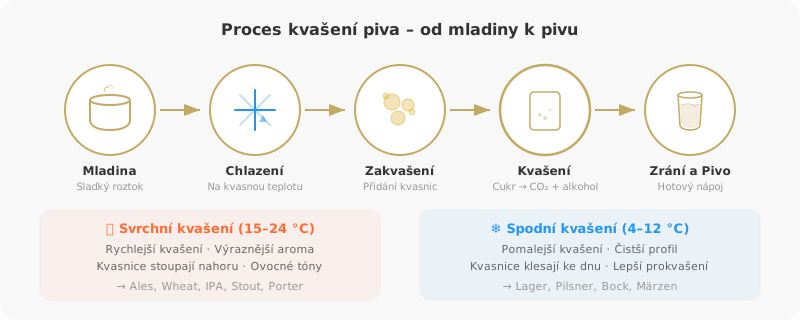
Bottom fermentation requires more time and patience. While top-fermented beer can be ready in 1–2 weeks, lagers (from the German "lagern" – to store) typically age for 4–8 weeks, sometimes longer. This longer aging period contributes to a rounded flavor and elimination of off-flavors.
🍻 Typical bottom-fermented styles
- Pilsner – Czech and German styles with prominent hop bitterness
- Lager – Clean, refreshing and easy-drinking
- Bock – Stronger lager with malty character
- Märzen / Oktoberfest – Amber beer with a rich body
- Schwarzbier – Dark lager with gently roasted tones
Comparison at a Glance
| Property | 🌡️ Top Fermentation | ❄️ Bottom Fermentation |
|---|---|---|
| Temperature | 15–24°C | 4–12°C |
| Speed | Faster (1–2 weeks) | Slower (4–8 weeks) |
| Yeast Position | Rises to the surface | Sinks to the bottom |
| Flavor Profile | Distinctive, complex, fruity | Clean, smooth, refreshing |
| Attenuation | Medium | High (better sugar processing) |
| Esters & Phenols | More – fruity, spicy tones | Less – cleaner profile |
| Typical Styles | Ale, IPA, Wheat, Stout | Lager, Pilsner, Bock |
Yeast is alive – and must be treated accordingly
Whether you're brewing top or bottom-fermented beer, yeast is always a living organism and requires appropriate care. In the brewery, we treat it with respect, because its health directly determines the quality of the final beer.
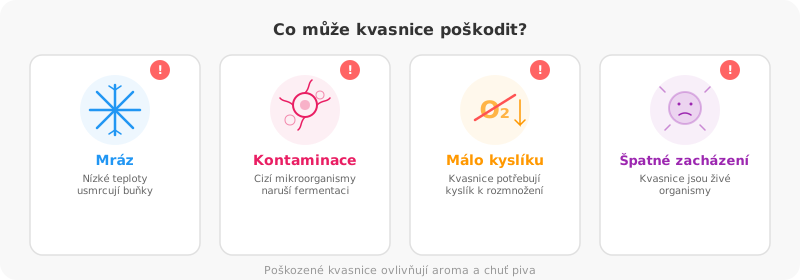
Frost can kill yeast – frozen cells burst and lose their ability to ferment. Contamination by foreign microorganisms (bacteria or wild yeasts) can completely change the beer's character and cause off-flavors. Lack of oxygen in the initial phase of fermentation prevents healthy yeast reproduction – they need it to build cell membranes.
And finally – even rough handling, such as temperature shocks, sudden mechanical stress or improper storage, can irreparably damage yeast. Such damaged yeast then produces unwanted aromatic compounds that manifest as off-flavors – metallic, papery or solvent-like tastes in the beer.
"Yeast is the heart of every beer. You can have the best malt and hops in the world, but if you don't take care of your yeast, the result will always be a disappointment."
– Adam Roudnický – Brewmaster
What does this mean for beer lovers?
Next time you order a beer, try to think about the process it went through. If you're holding a Czech lager or pilsner, you know that yeast patiently worked in the cold for many weeks to offer you a clean and refreshing taste. And if you're having an IPA or wheat beer, appreciate those complex fruity and spicy tones that are the gift of active top-fermenting yeast.
At Andělský Pivovar, we brew both types of beer and approach each one with maximum care. Our yeast gets the best conditions – the right temperature, enough oxygen, a sterile environment and most importantly – respect. Because that's where the magic of every sip lies.
Taste the difference for yourself
Come to Andělský Pivovar and compare top and bottom-fermented beers straight from the tank.
Reserve a Table