Brewing beer looks like a romantic job where you stand by the kettle for a while, stir the mash, add hops, and then spend a few weeks nurturing and tasting beer from the tank. But it's not quite like that. The reality is far more mundane – yet incredibly important.
A large and very important part of brewing is actually cleaning, disinfection and rinsing. Simply put – cleanliness. And it's no small matter – brewers say that up to 80% of their work consists of sanitation. Why? Because any contamination could ruin an entire batch, and that simply cannot happen.
Why is cleanliness so critical in a brewery?
Beer is a living product. During fermentation, yeast converts sugars into alcohol and CO₂, and it's precisely in this sweet, warm and moist environment that unwanted microorganisms also thrive – bacteria, molds and wild yeasts. A single impurity, a single drop of contaminated water or a poorly cleaned hose, and the entire batch is ruined.
⚠️ What happens with poor sanitation?
- Sour flavors – Lactobacillus bacteria produces lactic acid
- Vinegar taste – Acetobacter bacteria converts alcohol to vinegar
- Cloudy beer – wild yeasts cause haze and sediment
- Off-flavors – phenolic, solvent-like or medicinal tones
- Overpressure in bottles – uncontrolled fermentation can cause explosions
A contaminated batch cannot be fixed – the entire thing must be dumped. That means a loss of ingredients, energy, time and money. That's why every professional brewery follows one rule: sanitation is the foundation of everything.
Why do we use stainless steel vessels and pipes?
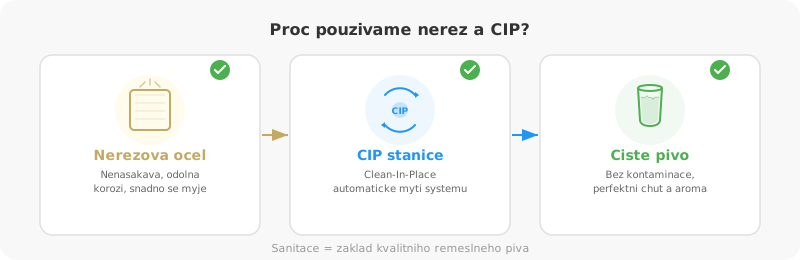
At Andělský Pivovar, we exclusively use stainless steel (typically AISI 304 or 316) for all vessels, tanks, pipes and fittings. Stainless steel is ideal for brewing for several reasons:
- Non-absorbent – unlike wood or plastic, stainless steel doesn't absorb bacteria or odors
- Corrosion resistant – withstands acids and caustics used in sanitation
- Smooth surface – minimizes places where microorganisms could take hold
- Easy to clean – can be washed at high temperatures without damage
- Long lifespan – stainless steel tanks last for decades
Our CIP Station – the heart of brewery hygiene
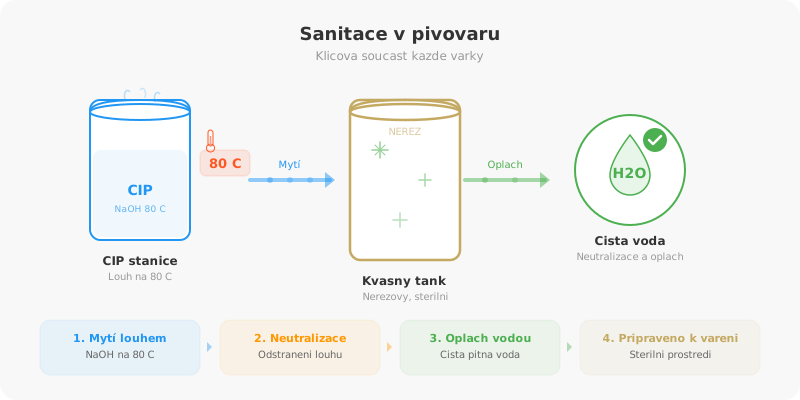
For thorough cleaning and disinfection, we use our CIP station (Clean-In-Place). It's an automated system that allows us to clean the entire brewery circuit – tanks, pipes, valves and tap heads – without having to disassemble anything.
The principle is simple but effective: in the CIP station we heat caustic soda (NaOH) to 80°C and thoroughly flush the entire system with it. The hot caustic perfectly dissolves organic deposits – residues of proteins, sugars, hop resins and yeast sediments that accumulate on vessel walls and in pipes during brewing and fermentation.
"Our CIP station is like a dishwasher for the entire brewery. Hot caustic runs through every millimeter of pipes and tanks, reliably removing everything that shouldn't be there. Without it, we couldn't brew quality beer."
– Adam Roudnický – Brewmaster
How does the sanitation cycle work?
The entire sanitation process has several precisely defined steps. Each one is important and cannot be skipped:
Pre-rinse
Cold water removes coarse impurities
Caustic wash
NaOH at 80°C dissolves organic residues
Neutralization
Thorough removal of caustic residues
Final rinse
Clean drinking water – system is ready
But don't worry – before we return beer to the pipes, we always neutralize and rinse with clean water. The final rinse is done with drinking water, and only then can the system come into contact with beer again. At the end of each sanitation cycle, we check the pH to make sure no cleaning agent residues remain in the system.
🧪 Fun fact: Why caustic soda?
Sodium hydroxide (NaOH) has been a standard cleaning agent in brewing for decades. At 80°C it perfectly dissolves proteins and fats. It's easily neutralized with acid and rinses off well with water. Some breweries also use acid cleaning (phosphoric acid) to remove mineral deposits – so-called "beer stone."
Sanitation isn't just about tanks
Cleanliness in a brewery doesn't just concern fermentation tanks and brewing. Sanitation covers absolutely everything:
- Brew house – lauter tun, mash tun, brew kettle
- Fermentation tanks – cylindroconical tanks (CCT) and lager tanks
- Pipe systems – all piping and hoses
- Dispensing equipment – taps, compensators, dispensing hoses
- Filling line – bottles, cans, closures
- Floors and drains – prevention of mold and bacterial biofilms
- Small equipment – measuring cylinders, sample vessels, yeast piping
A brewer = a top-notch cleaner
It might surprise you, but a brewer spends more time cleaning than actually brewing. A typical day in a brewery goes like this: clean and disinfect everything needed in the morning, then brew or package, and then clean and disinfect again. And tomorrow, the same thing.
It's work that never appears in any marketing video. Nobody posts photos of pipe cleaning on Instagram. But without this tireless attention to cleanliness, no quality craft beer would exist. Sanitation is the true unsung hero of every great batch.
"When someone asks me what I do for a living, I say: I wash tanks and sometimes brew beer. In that order. Because without clean tanks, no good beer exists."
– Adam Roudnický – Brewmaster
What does this mean for you?
Next time you drink a beer from Andělský Pivovar, know that behind its clean taste are not only quality ingredients and craft skill, but also hours of careful sanitation. Every tank, every pipe, every valve has been thoroughly washed and disinfected so that only what belongs ends up in your glass – great beer.
Come see how it works
Reserve a table and take a close look at our brewery – including the CIP station!
Reserve a Table